⏳ 3 min
I first met the Braingineers team exactly one year ago, when I began my master’s thesis under the supervision of Prof. Mattia Veronese. The project was part of a fascinating collaboration with King’s College and GSK, with an ambitious goal: to identify diagnostic and prognostic biomarkers of Parkinson’s disease in early stage patients through the use of perturbation covariance analysis applied to multimodal neuroimaging data, including PET and MRI.
For me, it was both an exciting and challenging beginning. Entering a new field meant stepping into an environment where every day there was something new to learn: new methods to understand, new questions to tackle, and new perspectives to embrace. It was a journey of constant growth, thanks to the guidance of my supervisor and the support of my colleagues.
In April, I graduated, and soon after I had the chance to continue this path as a research assistant, carrying forward my thesis project. The mission was to finalize the analyses and to write a paper, transforming months of work and exploration into something concrete and hopefully valuable for the scientific community.
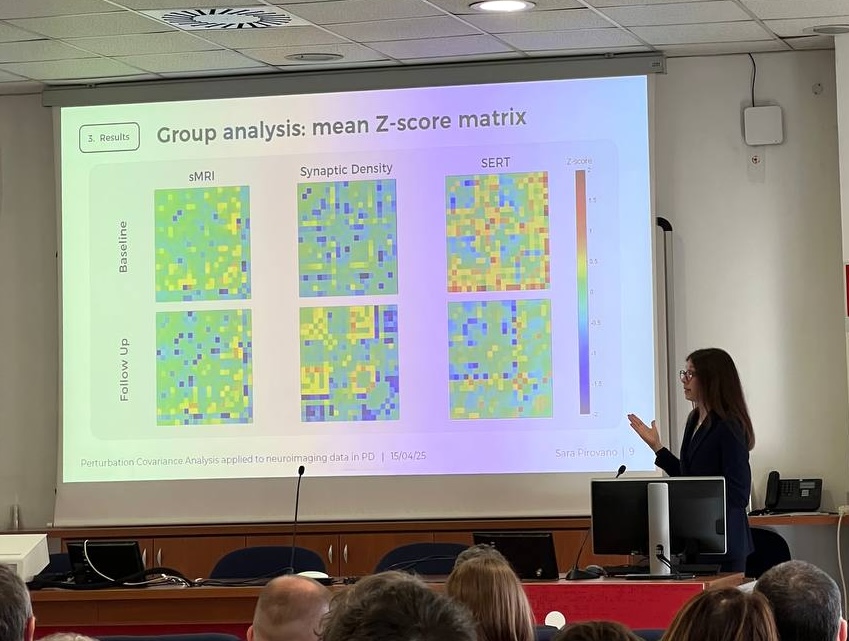
Our analyses showed that perturbation analysis can sensitively capture brain network alterations linked to Parkinson’s disease and their progression over time. We found that MRI and PET data offer complementary insights: while MRI measures were strongly related to motor symptoms, PET data reflected dopaminergic loss in key brain regions. These results support the potential of this approach as a promising tool for early diagnosis and monitoring of disease progression.
Working with the Braingineers team has been an immensely enriching and formative experience. Their expertise, dedication, and collaborative spirit created the ideal environment to grow not only as a researcher, but also as a person. Every challenge we faced turned into an opportunity to learn, and every discussion opened new ways of thinking.
Now that the analyses are completed and the paper has been written, this chapter of my journey comes to an end. Looking back, I feel grateful for the knowledge I have gained, the skills I have developed, and above all, the people I have had the privilege to work with.
I hope the work we have done can contribute, even in a small way, to advancing the understanding of Parkinson’s disease and supporting those who dedicate their lives to improving patient care. I will carry this experience with me as a precious milestone, both professionally and personally.
Thank you!
• • •
Ho conosciuto il team dei Braingineers esattamente un anno fa, quando ho iniziato la mia tesi magistrale sotto la supervisione del Prof. Mattia Veronese. Il progetto faceva parte di una collaborazione con il King’s College e GSK, con un obiettivo ambizioso: identificare biomarcatori diagnostici e prognostici del morbo di Parkinson in pazienti nelle fasi iniziali, utilizzando la perturbation covariance analysis applicata a dati multimodali di neuroimaging, tra cui PET e risonanza magnetica.
Per me è stato un inizio tanto entusiasmante quanto impegnativo. Entrare in un nuovo ambito significava immergersi in un ambiente in cui ogni giorno c’era qualcosa di nuovo da imparare: nuovi metodi da comprendere, nuove domande da affrontare e nuove prospettive da esplorare. È stato un percorso di crescita costante, grazie alla guida del mio supervisor e al supporto dei miei colleghi.
Ad aprile mi sono laureata e, poco dopo, ho avuto l’opportunità di continuare questo cammino come research assistant, portando avanti il progetto di tesi. L’obiettivo era completare le analisi e scrivere un paper, trasformando mesi di lavoro e analisi in qualcosa di concreto.
Le nostre analisi hanno mostrato che la perturbation analysis può catturare in modo sensibile le alterazioni delle reti cerebrali legate al Parkinson e alla sua progressione nel tempo. Abbiamo osservato che dati MRI e PET offrono prospettive complementari: mentre i dati ottenuti dalla risonanza magnetica erano fortemente associati ai sintomi motori, i dati PET riflettevano la perdita dopaminergica in aree chiave del cervello. Questi risultati supportano il potenziale di questo approccio come strumento promettente per la diagnosi precoce e il monitoraggio dell’avanzamento della malattia.
Collaborare con il team dei Braingineers è stata un’esperienza estremamente arricchente e formativa. La loro competenza, dedizione e spirito di collaborazione hanno creato l’ambiente ideale per crescere non solo come ricercatrice, ma anche come persona. Ogni sfida affrontata si è trasformata in un’opportunità di apprendimento e ogni discussione ha aperto nuove prospettive.
Ora che le analisi sono concluse e il paper è stato scritto, questo capitolo del mio percorso giunge al termine. Guardando indietro, mi sento grata per le conoscenze acquisite, le competenze sviluppate e, soprattutto, per le persone con cui ho avuto il privilegio di lavorare.
Spero che il lavoro che abbiamo svolto possa contribuire, anche solo in piccola parte, a far progredire la comprensione del morbo di Parkinson e a supportare chi dedica la propria vita a migliorare la cura dei pazienti. Porterò con me questa esperienza come una tappa preziosa, sia professionalmente che personalmente.
Grazie!
Sara Pirovano
TESTO ENG – Lorem ipsum dolor sit amet, consectetur adipiscing elit. Ut elit tellus, luctus nec ullamcorper mattis, pulvinar dapibus leo.
• • •
TESTO ITA – Lorem ipsum dolor sit amet, consectetur adipiscing elit. Ut elit tellus, luctus nec ullamcorper mattis, pulvinar dapibus leo.