

⏳ 3 min
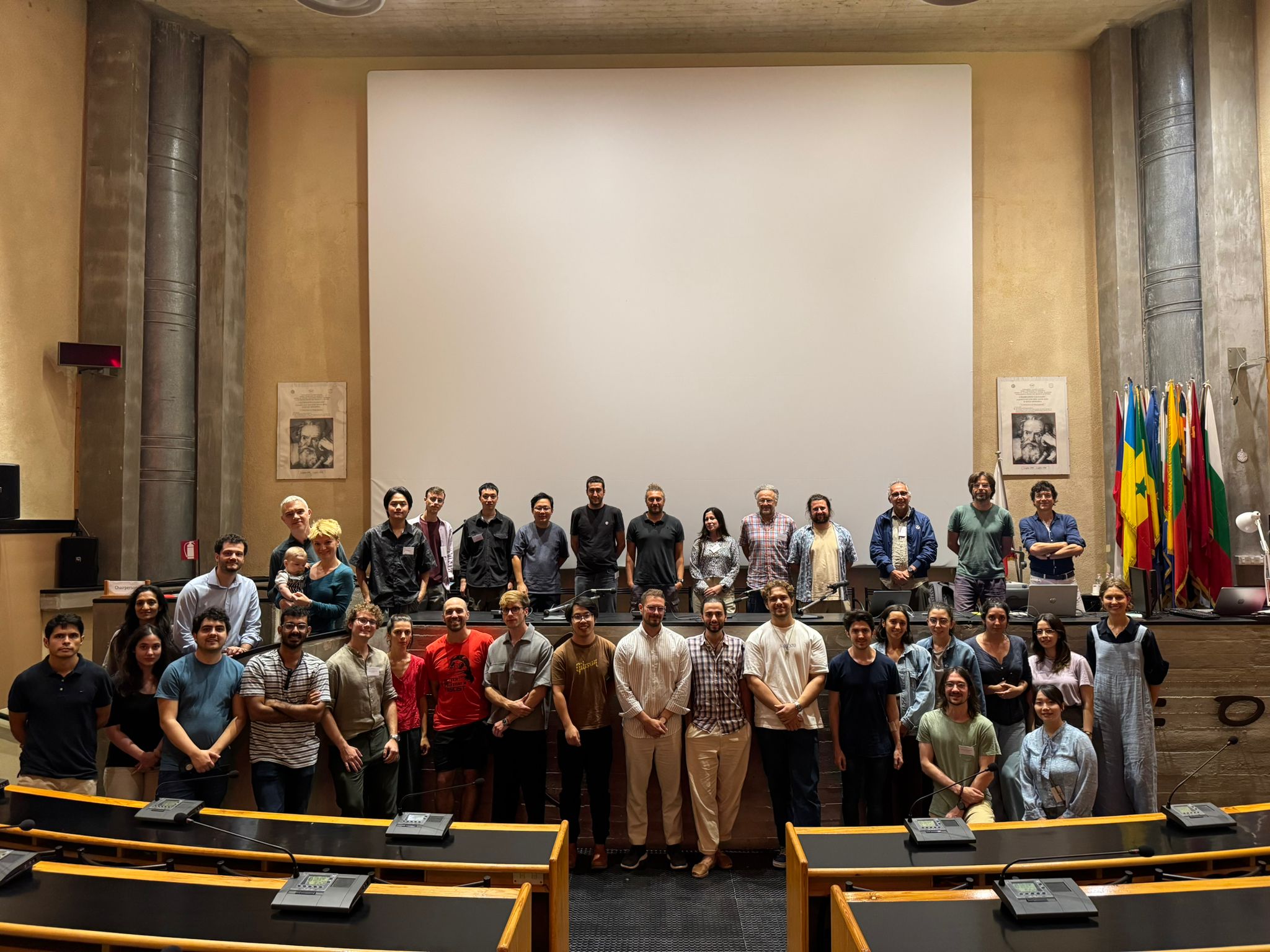
From August 25th to 31st, I had the privilege of attending the 20th Course of the School of Complexity: Higher-Order Interactions: Mechanisms, Behaviors, and Networks, held in Erice, Italy, and organized by the Ettore Majorana Foundation. This prestigious foundation, established in the 1960s by Professor Antonio Zichichi, has long been a hub for international scientific exchange.
The event brought together an extraordinary group of mathematicians, physicists, engineers, and neuroscientists from around the world, each contributing cutting-edge research on higher-order mechanisms, algebraic topology, and dynamical systems.
This was my first scientific school, and it was also the first time I found myself surrounded by such a diverse community of scholars, especially those with strong backgrounds in mathematics and physics. Engaging with them broadened my perspective and offered me entirely new ways of approaching scientific problems.
Learning directly from some of the leading experts in higher-order mechanisms not only deepened my understanding of the field but also inspired me to explore new applications in neuroscience. I began to see how these mathematical and topological tools could play a transformative role in future neuroimaging research.
Equally rewarding was the chance to meet and connect with many young scientists. The informal discussions, shared curiosity, and collaborative spirit fostered both meaningful professional connections and lasting friendships.
As part of this unique experience, I also had the honor of presenting my research during the poster session: “Riemannian Geometry Meets fMRI: Modeling of Correlation Manifolds, Eigenvector Subspaces, and Graph Curvature.”
In this work, I explore how concepts from differential geometry can enhance the analysis of neuroimaging data. By taking into account the intrinsic geometry of correlation structures, we can uncover patterns that standard linear methods often overlook. This geometric perspective opens the door to more robust and insightful analyses, potentially improving the interpretation of brain connectivity in health and disease.
Overall, the School of Complexity was a truly inspiring experience—one that not only expanded my scientific horizons but also reinforced the value of interdisciplinary dialogue in tackling some of today’s most challenging problems.
• • •
Dal 25 al 31 agosto ho avuto il privilegio di partecipare al 20° Corso della Scuola di Complessità: Higher-Order Interactions: Mechanisms, Behaviors, and Networks, tenutosi a Erice, in Italia, e organizzato dalla Fondazione Ettore Majorana. Questa prestigiosa istituzione, fondata negli anni ’60 dal Professor Antonio Zichichi, è da decenni un punto di riferimento per lo scambio scientifico internazionale.
L’evento ha riunito un gruppo straordinario di matematici, fisici, ingegneri e neuroscienziati provenienti da tutto il mondo, ciascuno portando contributi innovativi nel campo dei meccanismi di ordine superiore, della topologia algebrica e dei sistemi dinamici.
Questa è stata la mia prima scuola scientifica, e anche la prima volta in cui mi sono trovato circondato da una comunità così eterogenea di studiosi, in particolare con una forte formazione in matematica e fisica. Confrontarmi con loro ha ampliato la mia prospettiva e mi ha offerto nuovi modi di affrontare i problemi scientifici.
Imparare direttamente da alcuni dei massimi esperti nel campo delle interazioni di ordine superiore non solo ha approfondito la mia comprensione della materia, ma mi ha anche ispirato a esplorare nuove applicazioni in neuroscienze. Ho iniziato a vedere come questi strumenti matematici e topologici possano svolgere un ruolo trasformativo nella ricerca futura di neuroimaging.
Ugualmente gratificante è stata l’opportunità di incontrare e creare legami con molti giovani ricercatori. Le discussioni informali, la curiosità condivisa e lo spirito collaborativo hanno favorito sia connessioni professionali significative sia amicizie durature.
Come parte di questa esperienza unica, ho avuto anche l’onore di presentare la mia ricerca durante la sessione poster: “Riemannian Geometry Meets fMRI: Modeling of Correlation Manifolds, Eigenvector Subspaces, and Graph Curvature.”
In questo lavoro esploro come i concetti di geometria differenziale possano arricchire l’analisi dei dati di neuroimaging. Considerando la geometria intrinseca delle strutture di correlazione, è possibile individuare schemi che i metodi lineari standard spesso trascurano. Questa prospettiva geometrica apre la strada ad analisi più robuste e approfondite, con il potenziale di migliorare l’interpretazione della connettività cerebrale in condizioni di salute e di malattia.
Nel complesso, la Scuola di Complessità è stata un’esperienza davvero ispiratrice — non solo ha ampliato i miei orizzonti scientifici, ma ha anche rafforzato il valore del dialogo interdisciplinare nell’affrontare alcune delle sfide più complesse del nostro tempo.
Leave a Reply