

⏳ 3 min
Brain‑Age Poster & Normative Model of Choroid‑Plexus Volume Talk
From July 14 to 17 I had the pleasure of attending the 47th IEEE Engineering in Medicine & Biology Society (EMBS) Conference — EMBC 2025 in Copenhagen. With more than 3 000 participants, EMBC is one of the largest gatherings in biomedical engineering, covering everything from implantable sensors to AI‑driven diagnostics. Imaging — and neuroimaging in particular — is still a niche within the meeting, yet the program was packed with talks on structural MRI, functional MRI, EEG, and even a few molecular‑imaging sessions. Copenhagen’s long summer light and bike‑friendly streets made a perfect backdrop for four days of science overload.
My personal highlight came during the Wednesday early‑afternoon poster session, where I presented my joint work with Valentina Sammassimo, “Comparison of Statistical Methods for Brain‑Age Prediction Using Neuroimaging Data”. We benchmarked 25 machine‑learning regressors on Cam‑CAN and evaluated them on HCP‑Aging to see how well accuracy survives when models cross scanners. The key takeaway: coupling a non‑linear SVM‑RBF with ComBat harmonization pushes external MAE down and virtually removes age bias; without harmonization, the ensemble XGB remains the steadiest traveler, showing that real success hinges on both the model and the preprocessing.
Even though neuroimaging is a small slice of EMBC, a steady stream of attendees stopped by the poster to chat, ask detailed questions, and share ideas for follow‑up work — proof that interest in brain‑age estimation is growing fast.
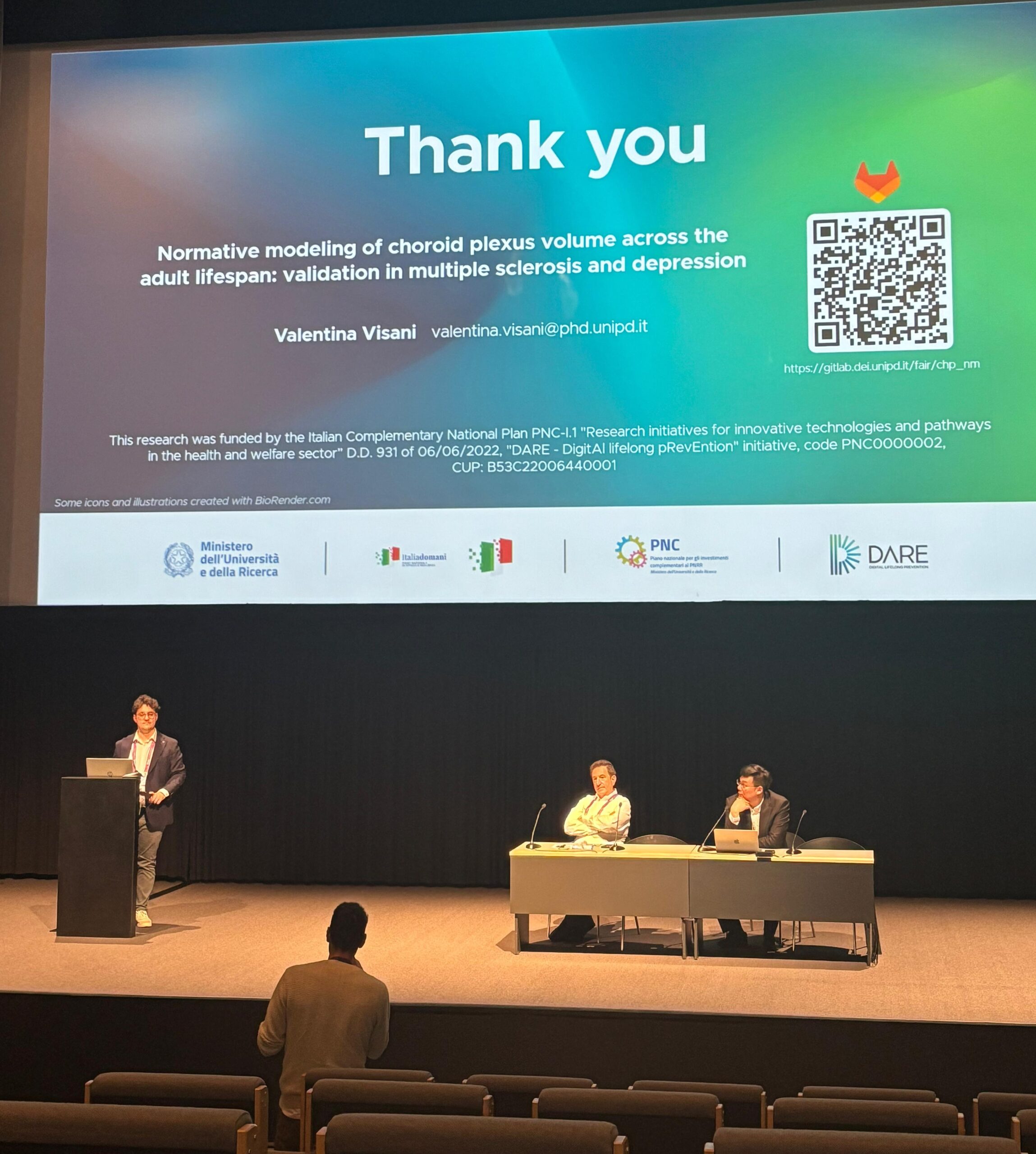
I also had the privilege of giving an oral presentation on behalf of Valentina Visani. Her contribution, “Normative Modeling of Choroid Plexus Volume Across the Adult Lifespan: Validation in Multiple Sclerosis and Depression”, introduces a hierarchical Bayesian reference for choroid‑plexus volume and shows how it flags individual deviations in MS and depression cohorts. The talk was well received; the audience engaged in a lively, productive Q&A that sparked several potential collaborations.
Many thanks to Valentina Sammassimo, Manuela Moretto, and Mattia Veronese for the teamwork on the brain‑age project, and to Valentina Visani for trusting me with her microphone.
See you all at EMBC 2026 in Toronto!
• • •
Poster su Brain‑Age e Talk sul modello normativo del Volume del Plesso Coroideo
Dal 14 al 17 luglio ho avuto il piacere di partecipare alla 47ª IEEE Engineering in Medicine & Biology Society Conference – EMBC 2025 a Copenaghen. Con oltre 3 000 partecipanti, l’EMBC è uno dei maggiori eventi di ingegneria biomedica, capace di spaziare dai sensori impiantabili alla diagnostica guidata dall’AI. L’imaging, e il neuroimaging in particolare, resta un tema di nicchia nel programma, ma c’erano comunque numerosi interventi su MRI strutturale, fMRI, EEG e perfino qualche sessione di molecular imaging. Le lunghe giornate estive e le piste ciclabili di Copenaghen sono state la cornice ideale per quattro giorni di full‑immersion scientifica.
Il momento clou per me è arrivato mercoledì, nella sessione poster del primo pomeriggio, dove ho presentato il lavoro svolto insieme a Valentina Sammassimo, “Comparison of Statistical Methods for Brain‑Age Prediction Using Neuroimaging Data”. Abbiamo confrontato 25 regressori di machine learning su Cam‑CAN e li abbiamo testati su HCP‑Aging per capire quanto bene la precisione sopravviva al cambio di scanner. Il messaggio chiave è che la combinazione SVM‑RBF con ComBat riduce l’MAE esterno e praticamente elimina il bias d’età; senza armonizzazione l’XGB rimane il modello più “robusto in viaggio”, a dimostrazione che servono sia il modello giusto sia il preprocessing adeguato.
Pur essendo il neuroimaging un argomento di nicchia all’EMBC, un buon numero di partecipanti si è fermato al poster per domande e suggerimenti, segno che l’interesse verso il brain‑age sta crescendo rapidamente.
Ho avuto anche l’onore di tenere una presentazione orale per conto di Valentina Visani. Il suo contributo, “Normative Modeling of Choroid Plexus Volume Across the Adult Lifespan: Validation in Multiple Sclerosis and Depression”, introduce un modello normativo bayesiano gerarchico per il volume del plesso coroideo e mostra come è possibile individuare deviazioni in coorti di sclerosi multipla e depressione. Il talk è stato accolto con interesse e il Q&A finale ha generato spunti di collaborazione.
Un sentito grazie a Valentina Sammassimo, Manuela Moretto e Mattia Veronese per il lavoro di squadra sul progetto brain‑age, e a Valentina Visani per la fiducia nel farmi da suo portavoce.
Ci vediamo tutti all’EMBC 2026 di Toronto!
Leave a Reply