⏳ 4 min
It’s been a little over six months since I started my PhD in Bioengineering, and although I’m just at the beginning of this journey, I’ve already had the chance to explore exciting research paths and take part in meaningful experiences that helped shape my direction.
My main interests lie in neuroimaging, particularly MRI, and the application of artificial intelligence and mathematics to better understand the brain — a combination that fits perfectly within the spirit of the Braingineers community.
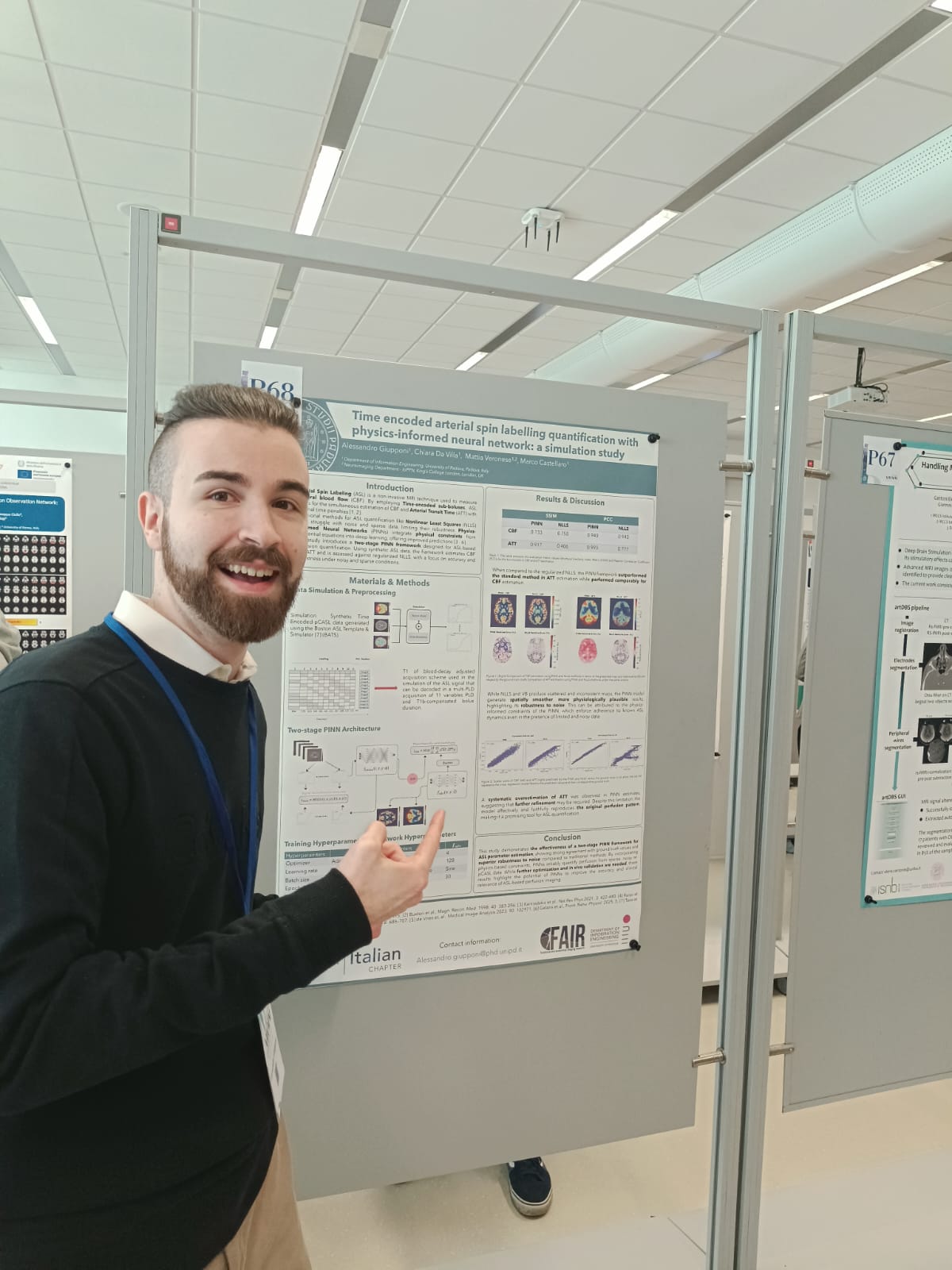
My first real step into the research world happened earlier this year, when I attended XVI National Congress of the Italian Association of Magnetic Resonance in Medicine (AIRMM) There, I presented a poster as first author, focused on my PhD project: the quantification of time-encoded arterial spin labeling images using Physics-Informed Neural Networks (PINNs). This was my first opportunity to present my work to the scientific community, and I was excited to see the interest
and receive feedback that helped me refine both my ideas and the way I communicate them.
Alongside that, a second poster based on the thesis work of a Master’s student I had been mentoring was also accepted. This project explored brain age prediction using Kolmogorov-Arnold Networks applied to 3D T1-weighted MRI. Guiding a student through their thesis during my first few months as a PhD candidate was both challenging and rewarding. It allowed me to support someone else; learning while exploring a new and complementary research direction myself.
More than just a side task, it became a valuable learning experience — both in scientific exploration and in developing skills I know will be important in the future.
After AIRMM, I focused on extending both of these projects into short papers for the upcoming Medical Imaging with Deep Learning (MIDL) 2025 international conference in Salt Lake City. It was my first time writing a structured scientific paper, even if only three pages long, and it proved to be both motivating and challenging. The first paper expanded on the ASL quantification work,
incorporating the improvements made since the AIRMM presentation. The second paper revisited the student’s thesis project — this time with additional analysis and more advanced results, continuing a line of research I believe has great potential. When I received the acceptance emails, I was genuinely thrilled. Having two posters accepted at an international conference felt like a milestone — a validation of my early efforts and a chance to share my ideas with a broader, international community of researchers working at the intersection
of medical imaging and machine learning.
One of the most interesting parts of this process was reading the reviewers comments. Seeing what experts appreciated, questioned, or suggested really opened my eyes to how my work is perceived from the outside. It reminded me that research is not a solitary activity — it’s a conversation, a constant back-and-forth between ideas, results, doubts, and improvements. Sharing work and receiving feedback is what drives growth, and that’s something I’m starting to appreciate more and more.
At the moment, I’m completing the last changes to the posters based on the reviewers’ suggestions and preparing for my trip to Salt Lake City. I’m looking forward to attending my first international conference, learning from others, and having the chance to discuss my research with people who share the same interests. I hope to return with new insights and ideas for my works.
While I prepare for MIDL, I’m also working on two new submissions for ESMRMB (European Society of Magnetic Resonance in Medicine and Biology). I’m excited about the possibility of attending more conferences and continuing to share my work with the scientific community.
Each step so far — from mentoring, to presenting, to writing, and now preparing to travel — has helped me grow, and I can’t wait to see where this journey will lead next.
• • •
Sono passati poco più di sei mesi dall’inizio del mio dottorato in Bioingegneria e, anche se sono solo all’inizio di questo percorso, ho già avuto l’opportunità di esplorare direzioni di ricerca stimolanti e di vivere esperienze significative che hanno contribuito a definire meglio il mio cammino.
I miei principali interessi riguardano il neuroimaging, in particolare la risonanza magnetica (MRI), e l’applicazione dell’intelligenza artificiale e della matematica per comprendere meglio il cervello — una combinazione che si sposa perfettamente con lo spirito della comunità Braingineers.
Il mio primo vero passo nel mondo della ricerca è avvenuto all’inizio di quest’anno, quando ho partecipato al XVI Congresso Nazionale dell’Associazione Italiana di Risonanza Magnetica in Medicina (AIRMM). In quell’occasione ho presentato un poster come primo autore, incentrato sul mio progetto di dottorato: la quantificazione delle immagini time-encoded arterial spin labeling tramite Physics-Informed Neural Networks (PINNs). È stata la mia prima occasione per presentare il mio lavoro alla comunità scientifica, ed è stato entusiasmante vedere l’interesse suscitato e ricevere commenti utili che mi hanno aiutato a migliorare sia le idee che il modo di comunicarle.
Insieme a questo, è stato accettato anche un secondo poster, basato sul lavoro di tesi di uno studente magistrale che ho seguito come correlatore. Questo progetto riguardava la predizione dell’età cerebrale attraverso l’uso delle Kolmogorov-Arnold Networks applicate a immagini MRI 3D T1-pesate. Seguire uno studente durante i primi mesi del mio dottorato è stata un’esperienza tanto impegnativa quanto gratificante: mi ha permesso di mettere a disposizione le mie conoscenze per aiutare un’altra persona, esplorando al tempo stesso una linea di ricerca nuova e complementare. Più che un’attività secondaria, è diventata per me un’esperienza preziosa — sia dal punto di vista scientifico che dal punto di vista umano, aiutandomi a sviluppare competenze che so saranno importanti in futuro.
Dopo AIRMM, mi sono concentrato sull’estensione di entrambi i progetti in forma di articoli brevi per la conferenza internazionale Medical Imaging with Deep Learning (MIDL) 2025, che si terrà a Salt Lake City. È stata la mia prima esperienza di scrittura di un paper scientifico strutturato, anche se breve (solo tre pagine), ed è stato al tempo stesso una sfida ma anche molto stimolante. Il primo articolo ha approfondito il lavoro sulla quantificazione ASL, includendo i miglioramenti apportati dopo la presentazione all’AIRMM. Il secondo ha ripreso il progetto dello studente, arricchito da nuove analisi e risultati più avanzati, portando avanti una linea di ricerca che ritengo molto promettente.
Quando ho ricevuto le email di accettazione, ero molto entusiasta. Vedere accettati due poster a una conferenza internazionale è sembrato un traguardo importante — una conferma degli sforzi fatti finora e un’opportunità per condividere le mie idee con una comunità di ricercatori più ampia e internazionale, impegnata nel campo dell’imaging medico e del machine learning. Uno degli aspetti più interessanti di questo processo è stato leggere i commenti dei revisori. Capire cosa è stato apprezzato, messo in discussione o suggerito dagli esperti mi ha aperto gli occhi su come il mio lavoro viene percepito dall’esterno. Mi ha ricordato che la ricerca non è un’attività solitaria: è un dialogo continuo tra idee, risultati, dubbi e miglioramenti. La condivisione del proprio lavoro e la ricezione di feedback sono ciò che permette di crescere, e sto imparando ad apprezzare sempre di più questo aspetto.
In questo momento sto completando le ultime modifiche ai poster, seguendo le indicazioni dei revisori, e mi sto preparando per il viaggio a Salt Lake City. Non vedo l’ora di partecipare alla mia prima conferenza internazionale, imparare da altri ricercatori e avere l’occasione di confrontarmi con persone che condividono i miei stessi interessi. Spero di tornare con nuove idee e spunti per i miei progetti.
Mentre mi preparo per il MIDL, sto anche lavorando a due nuove sottomissioni per ESMRMB (European Society of Magnetic Resonance in Medicine and Biology). Sono entusiasta all’idea di poter partecipare ad altre conferenze e continuare a condividere il mio lavoro con la comunità scientifica.
Ogni passo fatto finora — dall’assistenza, alla presentazione, alla scrittura, fino alla preparazione per il viaggio — mi ha aiutato a crescere, e non vedo l’ora di scoprire dove mi porterà questa avventura.